

Wānaka man becomes Otago’s oldest PhD graduate

Sue Wards
17 December 2025, 4:00 PM
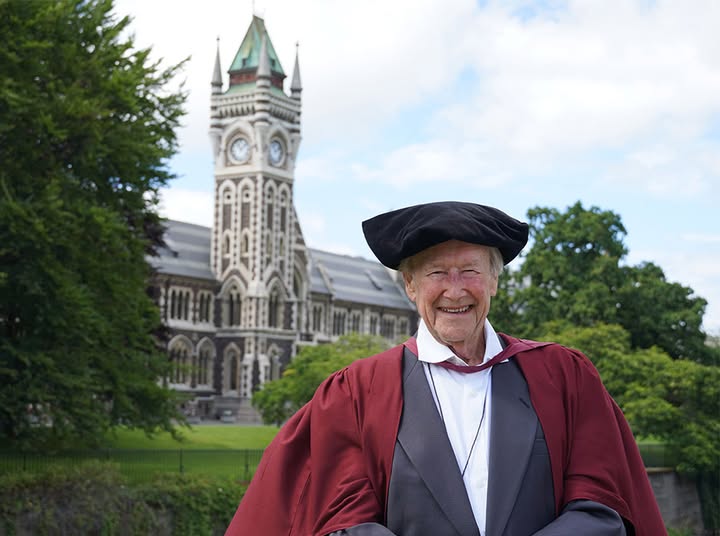 Peter Duncan, PhD
Wānaka resident Peter Duncan, 88, has become what the University of Otago believes to be its oldest PhD graduate.
Peter graduated on Saturday (December 13) with a Doctor of Philosophy in Education, and was acknowledged by the university for his “lifetime of learning”.
He told the Wānaka App that while younger scholars “look upward and outward to a world they may wish to change”, he also “looked inward to almost 70 years of experience”.
His education has included teachers college, university, and the work community - for example, helping build the Roxburgh Dam, working in the office of former Prime Minister David Lange, and advising US education leaders.
Peter said his experiences in the United States evoked questions he wrestled with for most of his career, including how to move away from traditional whole-class, one-size-fits-all teaching toward managing each student’s individual learning needs.
To help him find the answers, he began his PhD in the aftermath of the Covid-19 pandemic by distance from Wānaka (his home since the 1990s, and before that as “a summer kid … until the late 1950s”).
His doctorate - Teachers’ Reflections of Changed Beliefs and Practices - follows the impact of early literacy development on teachers and how that shaped their students and careers through the following decades.
Working on his thesis was “an incredibly satisfying experience”, he said, and it was “very easy” to spend up to eight hours a day, and often longer, reading, writing, and thinking.
“The story in this research I had sat on for more than 20 years. With time, the unbounded support of my wife, and encouragement from my potential university supervisor, I began the journey. From that point on there was no conscious balance between life and study; one became the other.”
And while his PhD is completed, Peter has been talking to colleagues about collaborating on academic papers and possibly a book.
He hopes his research will have an ongoing impact.
“Our young people were once among the best readers and writers in the world as measured in international comparative testing up to the early 90s,” he said.
“My study suggested that if teachers had the opportunity to change their teaching beliefs and practices through a three-year school-based mentorship programme that developed their subject knowledge about literacy development, improved their instruction skills, and changed their classroom practices in ways that they could reach every student, literacy outcomes improved - in some schools significantly.
“Today, we might well reflect on the factors that influenced those outcomes.”
He told the Wānaka App that while people often think of lifelong learning as continuing to learn in formal situations, learning can be adapting to a changing environment as we age.
“If we are able, what we can do is be open to the changes we have to face, think about how we can adapt to them and in that sense take on this new learning. That is the real value of being open to new learning in your 80s.”
PHOTO: Supplied/University of Otago