


CODC grants Santana access in $1.25M deal

The Central App
02 February 2026, 6:00 PM
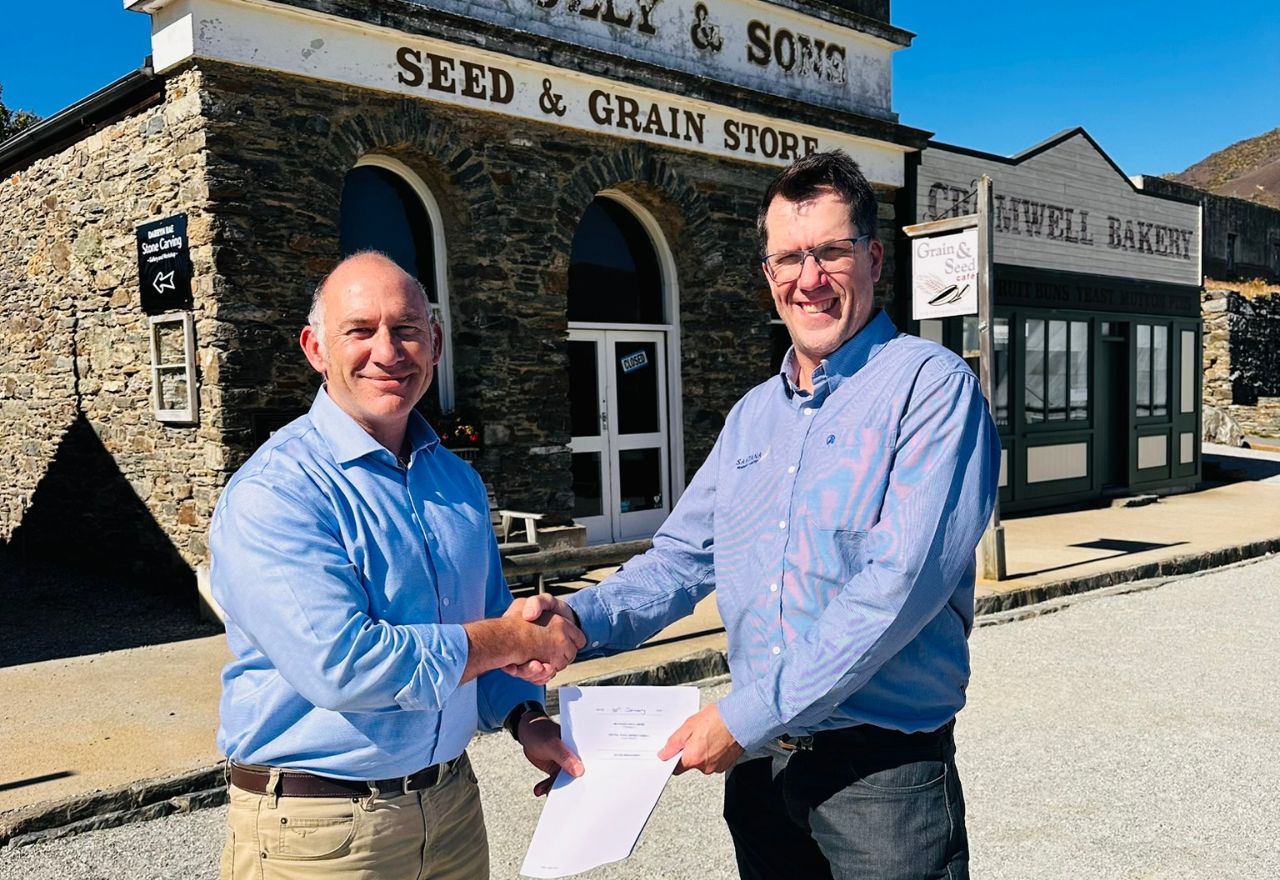 CODC's Peter Kelly, left, and Santana Minerals' Damian Spring pose after reaching an access and payment deal. Image: Supplied/Santana Minerals
Central Otago District Council has signed off a land access agreement with Santana Minerals for the proposed Bendigo-Ophir gold project that includes a million-dollar-plus annual payment to ratepayers.
The agreement, approved by elected members during a closed section of the council’s first meeting of the year on Wednesday (January 28), relates solely to access over council-owned roads under the Crown Minerals Act and does not constitute approval of mining activity.
It covers access along Thomsons Gorge Road and the Shepherds Creek paper road, including a 20-metre corridor on either side of those routes.
In a statement on Monday announcing the agreement, CODC chief executive Peter Kelly said the council was required, as a landowner, to consider and negotiate access arrangements where appropriate, but stressed it stopped short of providing green light for the mine itself.
“Approving this agreement provides clarity around access arrangements, but it does not predetermine whether the mine will proceed,” Peter said.
“That decision sits with the relevant consenting and regulatory processes.”
Any future road stopping would still require approval under the Public Works Act or the Local Government Act.
If any roads were stopped, replacement routes would be constructed to ensure continued public access.
Alongside access arrangements, the agreement sets out a community funding framework that would apply only if the project was ultimately consented and developed.
Under the agreement, Santana Minerals would make an annual payment of $1.25M to the council, indexed to CPI, starting six months after commercial gold production began.
The funding would be ring-fenced, administered by the council, and reported separately in its annual accounts.
Mayor Tamah Alley said the agreement ensured the district would receive a clear and transparent return from the use of council land if the project went ahead.
“This agreement ensures that if the project goes ahead, the Central Otago community receives tangible, long-term benefits, while maintaining transparency and public accountability,” Tamah said.
She said the council had not taken a position for or against the proposed mine.
“We acknowledge our community holds a wide range of views. Our focus is on ensuring decisions are made objectively, lawfully, and with full consideration of the information available,” she said.
Santana Minerals chief executive Damian Spring said finalising the agreement resolved a long-standing statutory requirement in a “pragmatic” manner.
“[It] provides durable clarity around roading and access arrangements, and establishes a transparent framework for long-term community benefit,” he said.
“It allows the project to progress in an orderly and disciplined way through the fast-track process, without pre-empting the outcome of that decision.”
However, local mine opposition group Sustainable Tarras is criticising the "behind closed doors" manner in which the agreement was reached.
"We've been in discussion with CODC on this very issue for well over six months. It's complex and has huge implications for the local community, including significant numbers of people who use these roads," the group said in a statement on Monday.
"We believe there are considerable legal pitfalls to granting access, and we have repeatedly pointed these out to CODC and cautioned them to take time to consult, consider the consequences and involve the wider community.
"Today, in announcing this behind-closed-doors decision, they've made it clear that community is secondary to their private negotiations with Santana."
The Bendigo-Ophir project is a proposed large-scale gold mine in the Dunstan Mountains near Cromwell and Tarras, now under consideration through the government’s fast-track approvals process.
The mining company said the site represents the largest gold discovery in New Zealand in more than 40 years, and its mine would be expected to produce 120,000 ounces annually at peak production, for 14 years, if developed.