

A gold mine, an Australia mining giant and a community divided

RNZ
03 March 2026, 9:22 PM
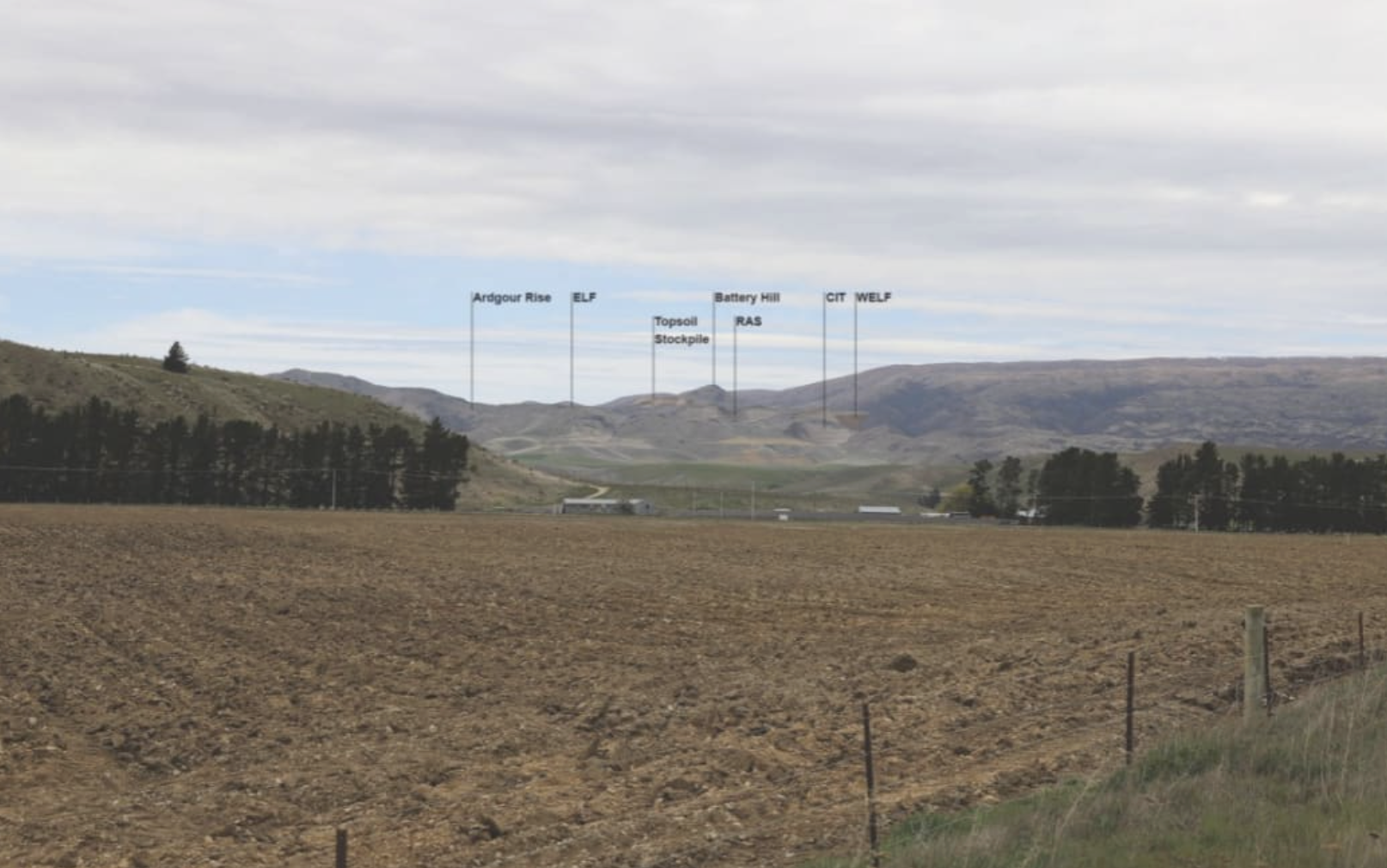 A visual simulation released by Santana Minerals showing what the mine would look like from Māori Point Road, Tarras. PHOTO: Supplied
A proposed gold mine is on the fast-track list. Proponents say it will bring jobs and money to the region, but opponents say it will be an economic 'short-term sugar hit ... with long-term consequences'.
Plans for a large, open cast gold mine in Central Otago are pitting locals against each other, while a mining industry executive says New Zealanders are too negative and catastrophise projects they don't understand.
Australian company Santana Minerals has applied for fast-track approval to build an open cast mine in the Dunstan mountain range, an hour's drive east of Queenstown, after discovering what it calls the largest single gold deposit in New Zealand in more than four decades.
According to the documents submitted to the fast-track panel, Santana will build four open mine pits. The largest, Rise and Shine Open Pit will be one kilometre long, 800 metres wide and 200 metres deep. There will also be three shallower pits, a processing plant that is one kilometre long and 120 metres wide, and a tailing storage facility to store mineral waste dust.
It says the project will employ hundreds of people and be worth $6 billion in revenue and more than $1b in taxes and royalties for New Zealand.
The fast-track panel is set to decide by late October and, if approved, it will be the first new mine to get the go-ahead under the accelerated process.
Opponents fear it will destroy threatened plants, scar the unique landscape and pollute the land and water. They say New Zealand will not get all the economic benefits because Santana is an Australian company, and they warn it will open the door to more mining in the region.
Two main groups are campaigning against the mine with backing from famous residents including actor Sir Sam Neill and painter Sir Grahame Sydney, as well as the former prime minister Helen Clark.
One of the groups, Sustainable Tarras, has already been fighting plans to build an international airport near the town. It calls the Santana proposal 'David versus Goliath' and is asking for donations to fund experts to fully understand the economic, environmental and social impacts of the mine.
"We are fighting this hard," it says on its website.
Artist Gregory O'Brien, who organised a fundraising exhibition for the group, says the "proposed desecration of a heritage area for purely monetary gain is an outrage to all of us, as it is to the citizens of Central Otago and to all New Zealanders".
"Painters, photographers, writers, film-makers, choreographers and other arts practitioners from within Central Otago and further afield are incensed at the churlishness of both the mining consortium and the Government's ruinous 'fast-track' (aka 'Highway to Hell') legislation.
"The environmental cost of such a cold-blooded, extractive exercise is simply too high, as is the social impact and down-stream legacy."
On the other side, Santana Mine Supporters, a Facebook group with 6,800 members says Central Otago "deserves opportunity - higher-paid local jobs, stronger regional businesses, and meaningful investment back into our community. We also believe development must be done properly, with high standards, transparency, and long-term accountability."
RNZ Central Otago reporter Katie Todd has spoken to many locals, including farmers who see it as a positive move for the region and a continuation of the area's mining legacy.
She says the application has been drawn out.
"Santana Minerals were asking for it to be considered within 30 days or so and we've recently learnt it's going to be more like 140 days.
"In part that's because of iwi opposition. Kā Rūnaka, which is a collective of Otago hapū, has raised concerns about potential Treaty settlement breaches and their concerns were described by the panel convenor of the fast-track application as significant and immutable.
"So that's going to be something to watch," says Todd.
Matthew Sole of Central Otago Environmental Society says communities are divided over the mine.
"There's a lot of tension in the community," he says. "There are certainly a lot of people for it.
"It's the comments you receive on social media when you try and put up a counter argument and the difficulty I find with it is it's actually hard to have a conversation."
Sole says many people are under financial pressure and are concerned about the country's future.
"I take a wider, longer term view that we've got to move on from exploitation to economies that have a right relationship with our environment. I think we've got to change away from these extractive processes to more enduring relationships and regenerative relationships with the land."
Sole has produced a YouTube video of the area that will be mined and points out unique, threatened plants and remnants of past mining endeavours that are part of its precious heritage that he says are at risk. He says the old mining era cannot be compared to today's.
"We're talking about two different things. The early mining was largely mining of individual endeavour and it was largely with human hands with the use of water," he says.
The impact of modern mining is "devastating, it has lost its context and meaning because of the vast industrial scale by massive machinery. We're not comparing like with like".
In a story for Newsroom last week, Jill Herron wrote that nearly a million hectares across Otago, and another 100,000 in Southland, are now at various stages of being "pegged" by gold mining companies.
But chief executive of New Zealand Minerals Council, Josie Vidal, says people have no need to panic and "possibly none" of the areas that have been identified on a minerals map drawn up by Earth Sciences New Zealand will be mined.
Heightened interest in the area is driven by the record price of gold, she says. She believes many will be hobby gold miners and doubts there would be any other large mines like Santana that are at a serious stage.
"There's a lot of interest in gold of the traditional gold mining areas of which Otago is one, and there's quite a lot of interest from smaller prospectors who could do quite well out of getting a fairly small amount of gold because the price is so high."
She calls the Santana proposal "a bog standard gold mine".
"I'm mystified by the attention. It's a gold mine like any other. There's no reason for it not to proceed."
When The Detail asked Santana for an interview, it replied in an email with a number of conditions.
On balance and representation it said, "Please confirm who else will be featured or interviewed, and whether local voices and businesses many of which support the project - not just high-profile critics - are being included to reflect the full spectrum of community sentiment".
It later declined our interview request but referred us it its 9,400-page application.
In an email, it said it welcomes scrutiny.
"What we cannot support is the amplification of assertions that have already been addressed, in writing, in data, numerous interviews and expert reports - simply because they are emotive or convenient to repeat and you haven't bothered to fact check their claims.
"If the program's objective is balance and informed debate, then the technical evidence must sit alongside the sentiment."